
Intelligent Design
Proof that Natural Causes cannot account for our existance!!!The Begining
The concepts presented here are the result of two things. The first was my training as an electronics and control theory engineer, coupled with my experience designing and building systems and machines in these fields. The second was attending the book release party of Steve Meyer’s “Signature in the Cell” book, where he gave a presentation and showed a video clip of ribosomes building a polypeptide chain.1 I realized that this was not chemistry – it was a nano-machine executing the process of building a protein. This shattered my education-induced impression that life was based on chemistry. The result was that I was thrust into the ID debate.
Most of my engineering training and career was spent designing and building process control systems and the systems that ran them, so what I learned at the party hit home. My knowledge of process control systems led me to realize that the field of biology was dealing with machines, as well as chemistry, not just chemistry. I found that many proteins are called enzymes, which are referred to as protein catalysts, and that catalysts are chemicals that accelerate chemical reactions. In other words, proteins are chemicals that speed up chemical reactions. An engineer would not call a ribosome’s work a chemical reaction – it is a machine building a molecule. This difference is profound. A chemical reaction is a result of Natural Causes, while machines are doing specified work and are designed by an abstract intelligent agent. These are two totally different paradigms. Although I could not explain this difference so succinctly at the end of this talk, I came away with the realization that something was wrong. Was I wrong about what I’d been taught, or was it something more?
So started my venture into the Intelligent Design debate. I’ve spent the last several years researching and thinking about this issue, aided by Steve’s organization, the Discovery Institute. The result is documented here.
ife is a Process
The first impression I had when seeing this video at Steve Meyer’s book release party was that I was watching machines performing work in a process. I am very familiar with process control technology because many of the products I designed during my engineering career either conducted processes or were components that were used in a process. In fact, one of the main products the company I founded, Vehicle Monitor Control, designs and builds systems that direct the work that takes place at vehicle assembly line stations. This work is a process, to add the work station “value add” designated to that work station, and to test, verify and document that the value add was done correctly and the vehicle was ready for the next work station.
But I was bothered by the fact that many details were missing. Notice how the (amino acid parts) “fly into place”. In reality, there has to be pre-assembly, staging of the parts, and delivery of the parts to the ribosome. I wondered if these details were left out because there was no awareness of the need for them or if they were omitted for the sake of simplicity.
The world of biology at that time recognized that there are molecular machines2 working in the cell performing tasks such as building proteins by the ribosome machine.
“The ribosome is an “RNA machine” that involves more than 300 proteins and RNAs to form a complex where messenger RNA is translated into protein, thereby playing a crucial role in protein synthesis in the cell. Craig Venter, a leader in genomics and the Human Genome Project, has called the ribosome “an incredibly beautiful complex entity” which requires a “minimum for the ribosome about 53 proteins and 3 polynucleotides,” leading some evolutionist biologists to fear that it may be irreducibly complex.”3
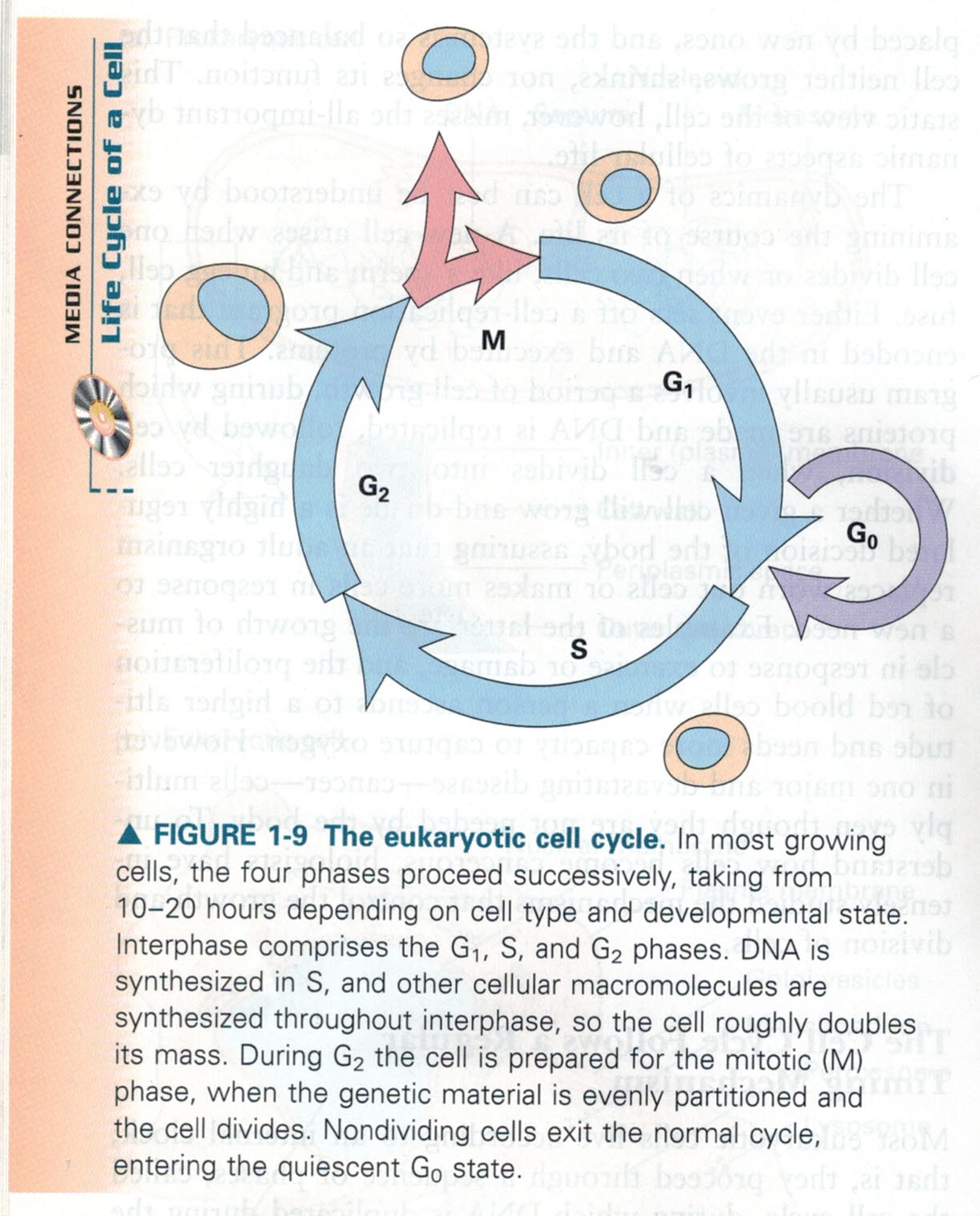
Figure 2. “Molecular Cell Biology”
The definition of a process is “a systematic series of actions directed to some end”. Watching this video shows the ribosome in action. It leaves no question about there being a series of actions in the process of building of a protein!
In addition to processes that occur on an “as needed” basis, like replacing a protein that has fallen to equilibrium and is no longer functional, there are “life cycle” processes that take place as shown in figure 2. Processes are typically botttom-up, top-down with layered individual smaller processes that are steps or supporting actions required to accomplish the overall process.4567
It seems obvious that biology is not just about chemistry, it is also about machines working in life processes. Life in every cell that has ever existed, in every life form that has ever lived on earth, and all of the interactions among life forms, is what his engineer thinks of as The Life Process. It is a hierarchy of processes over time, within cells and within life forms.
Biology Today – Headed Down the Wrong Path
It seems to me that the field of cellular biology has been proceeding down a path that is 90 degrees off course, based on the assumption that 50% of the types of molecules in a cell are the result of natural chemical reactions and 50% are the result of engineered molecules built by the molecular machinery in the cell.
Before the realization that molecular machines were responsible for the creation of proteins, it would have been logical to assume chemistry governed biology as it was the known method of manipulating chemicals to produce chemical products. Our ability to observe and measure what is actually happening in the cell was (and still is) very limited due to the molecule level size, the fact that it is not homogeneous, it is three dimensional and it is not static8 Non-biological chemistry can be studied in bulk quantities. Cellular life depends upon highly specified complex, and dynamic arrangements of matter/energy making bulk quantity studies of limited use, and makes reverse engineering virtually impossible.9 Despite the limitations, much has been learned about life, including the fact that it depends upon molecular machines.
Despite the fact that proteins are made by molecular machines, the field of biology has not embraced the profession that design and builds machines: engineering. It seems that the materialist ideology that rejects the possibility of design in biology causes biologists to view first life through a chemical evolution lens.
The failure of biology to accept life being engineered results in wasted resources, time, energy and I contend, lives. More about this later.
The Limitations of Natural Causes
Materialist contention that life is the result of Natural Causes is based on the premise that Natural Causes account for everything that exists. The assertion being made here is that his is not true; Natural Causes are capable of creating only a small fraction of the possible states of matter/energy that are theoretically possible based on the laws of physics. There are three reason provided here that rebuke this assertion: life is a process that requires logical functionality to work, which Natural Causes are incapable of, The Second Law of Thermodynamics, and logical analysis.
Life is a Process That Requires Logical Functionality
The fact that life is a process is not disputed. The common definition of a process is “a series of actions taken to actions taken to achieve an end.” Based on this definition, life is a process at all levels. All life, taken together is a process because life depends upon life – there is a food chain with recycling. Each organism has hundreds of processes that control the temperature, digestion, respiration, etc.. The same can be said about each cell with processes like repairing or replacing proteins, cell division, etc..
There are two types of processes, natural processes and intelligent processes. Natural processes are those that occur as a result of free energy resulting from natural causes and result in configurations of matter/energy such as atoms, molecules, planets, suns, and galaxies. On earth, they account for weather, erosion, rivers, terrain features, caves, etc.. The “end” achieved is without any intelligent influence save the possibility of an intelligent cause of the laws of physics.
The other type of process is an intelligent process that involves logical actions defined as Intelligent Work herein. Such a process requires the functionality of sensing conditions, called state variables by engineers, the ability to process the information, i.e., to determine action to take based on the state variables, and actuators, the means to apply the needed energy, using the needed form and amount over the needed time profile at the right place and orientation. This form of process must have a power source needed to accomplish the sensing and logic (think computer), but to perform the intelligent action. In other words, this power source must be controlled. It can be free energy such as wind or solar, but normally is not, more typically it will be batteries or gasoline, etc..
Processes require logical functionality because they
Natural Causes can only create a small subset of all matter/energy configurations. The Second Law of Thermodynamics is the reason as formally proved by Andrew McIntosh.10
Materialist have come to acknowledge that beginning life occurring by Natural Causes is insanely improbable, but insist that it must have happened because life does exist, and to think otherwise is unscientific. There are two problems with the materialist position. The first is that the probably of life occurring by Natural Causes is not insanely low, it is zero. The probability is zero not because of quantum theory, but because of logic.11 The second reason is that even if a protein happened to occur by Natural Causes, it would not last. The improbable state is an instantaneous state; it will not last long. For every state probability distribution curve there will be a “time in that state” probability curve.12 Again, this is a logical argument. Normally, the reason that a Natural state is so improbable in the first place its that the state is tenuously stable to begin with. We know this to be true for proteins because most of them have “half lives.” They fall out of their functional state after some short amount of time and have to be repaired or replaced to maintain life. There is no way for life to begin with these limitations as it eliminates the possibility of chemical evolution as an explanation of beginning life.13 The limitation of Natural Causes discussed here so far involve the impossibility of Natural Causes to build the molecules needed for life. But we haven’t talked about the even far greater problem: the embedded intelligence required in the matter/energy to perform Intelligent Work needed to conduct a process. A fundamental reason that Natural Causes cannot perform Intelligent Work is that work performed as a result of Natural Causes depends upon free energy.
Free Energy
In physics and chemistry, free energy refers to amount of internal energy available in a system available to do work. Normally, at standard conditions, as in a cell, it relates to the temperature gradient in a system, where the temperature in one part of the system is above the temperature in another part of the system. The higher temperature matter, has heat energy available or “free” to do work, But the energy source could be something different such as a impinging photon or some other particle. Whatever the form, free energy is energy resulting from natural causes that is available at some point in a system to do work.14
Another reality is that free energy disperses from its source. This is caused by the bulk properties (e.g. thermal conductivity) that result from the naturally caused equilibrium states (e.g., atoms and molecules). This means that if there is a requirement to provide a given amount of energy at some given point, the energy source would have to located at the exact point needed, and have to be the right amount, at the right time to achieve the required end, otherwise it would impact the adjoining matter. Natural causes have no method of delivering specified energy. This especially true in a cell because the cell is an enclosed space. The other problem in a cell is that there are thousands of different types of molecules (specified complexity), many with weak bonds, a necessary condition for functional proteins. Heat, the most common source of free energy will impact all of the cell bonds causing thousands of unwanted reactions for each desired action. The only source of energy that would impact a singular point within a cell15 would be a impinging particle, which, to do the required Intelligent Work, would have to impart the right amount of energy, at the right time, at the right place having evaded all of the intervening matter to get there.
These problems are overcome in cells by the Intelligent Work performed by the molecular machines in the cell, delivering ATP molecule(s) to the place needed and “firing” it (or them) at the needed point in time. An analogy in the macro world that we can relate to would be a hand drill that powered instead of batteries, fire crackers.
coupled with the fact that that the enzymes were really not catalysts of the same form of natural catalysts that involve intermediate reactions, However, the terminology nor the definitions of enzymes has not changed. This is one of many examples of where the jargon of biology has evolved on the assumption that life involves one science – chemistry This is a problem, as I’ve discovered, because the jargon of these fields is totally different. The term protein being considered a chemical and an enzyme defined as a catalyst are examples. Reading journal papers without much more biology background is very difficult due to terminology and test methodology.
is site is written by a retired electronics engineer whose undergraduate and graduate training revolved around control theory. My professional career involved the Apollo space mission, space telescope control system, guided drilling control, guided missile and aircraft control, control systems used on heavy equipment, and test systems for medicine and vehicles.
My interest in biology comes from the realization that life is a process, coupled with the knowledge, gained from experience, that Natural Causes are incapable of creating things that machines can. The first time I saw a video showing an interpretation of how the ribosome produced proteins, the realization that even inside the cell, processes like those I’ve spent my lifetime designing were running the show inside the cell. Watching that video, and many more since, I know that the video is showing “the big picture”, that there are many details, not being shown. Details like: how does the cell know when a protein needs to be produced? How is the raw materials prepared, delivered JIT? How is the process control system run (where is the computer, with all its working parts).
Looking into this conundrum more caused me to realize that the field of biology thinks of life as being chemistry. The terminology, cause and effect relationships all revolve around the idea that understanding life is understanding the chemistry of life. The idea that life is made possible due to machines, and thinking in terms of what a machine that the processes that make machines work is not addressed.
Engineer vs. Scientist
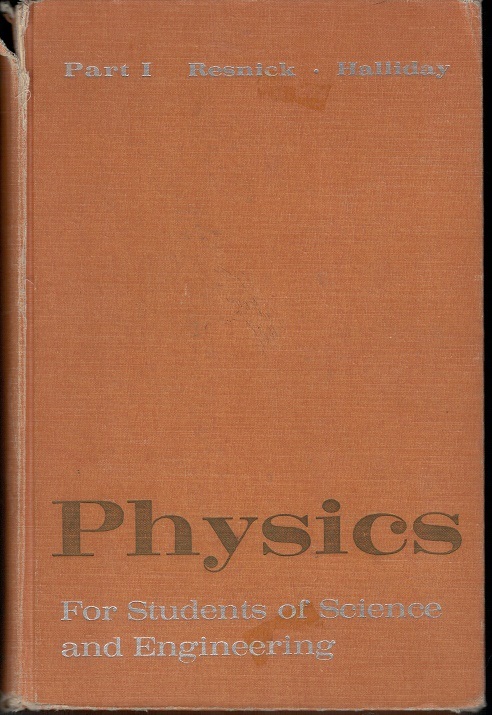
Figure 1. Fake Physics?
There are a number of definitions for an engineer. The one I like the best is this:16
Engineer:
noun: a person who designs, builds or maintains engines, machines, or public works.
synonyms: Originator, designer, inventor, developer, creator.
verb: Design and build (a machine or structure)
I always thought of an engineer as an applied scientist. Designing and building are two separate phases of an engineering project. Design involves creating the concepts and details that are documented so that the device can be built. The building includes the construction of a prototype, testing, and making design changes until the device performs its function as planned. I mention this because it seems, based on usage of terminology, that the Intelligent Design community is synonymous with “Engineer.”
Similarly, a scientist is defined as:17
Scientist:
noun: a person who is studying or has expert knowledge of one or more of the natural or physical sciences.
The difference between an engineer and a scientist is that an engineer has to make something work. To work, the object designed has to follow the real laws of physics and chemistry; not theory, not possibilities, but reality. Often times thinking purely in theoretical terms blinds one to common sense and/or other theory that is overlooked.18 The scientist deals with possibilities; the engineer must deal with the impossibilities.
When Steve played the video at his book release party, I really didn’t know what to expect as I thought that I was going to see exotic chemical reactions that worked in some magical fashion. I thought that some secret was going to be revealed.
What I saw instead was tasks being performed by molecular machines. Impossible! How could devices with the kind of functionality that I spent my life designing and building, except orders of magnitude more complex and capable be operating in the space of a cell? Impossible squared!! I knew that the video was a vastly simplified representation it did not show how the process was being orchestrated, how the parts were prepared, staged and delivered, etc..
In a very real sense, what I was witnessing was magic. To this day, I do not believe those in the field of biology realize the complexity of what must exist in the cell. Process control requires sensor, signal processing (think computer) functionality and actuators. It requires the acquisition and processing its own power. It has to get the energy and matter required. It has to get rid of the waste. And reproduction??? How in the world could that ever work?
I realized that the complexity of accomplishing all of the tasks necessary for life was something that could only be appreciated by an engineer who has had to make much simpler work. To be able to do it in the size of something as small as a cell was simply unfathomable. .
Proof Statements
The purpose of this site is to expound this engineer’s study and thinking about what life is from a physics/engineering point of view, and the implications of these thoughts. The result has some interesting twists so this story will start with the end – the conclusions, then work through the details and thought process. It starts with a proof, actually several logical proofs in one, of some of the principles that result from the line of thinking presented here.
The end point is very simple. Dead matter/energy is in the realm of science (follows the laws of physics) and live matter/energy is in the realms of philosophy (has embedded functional logical capability) AND science (follows the laws of physics).
This proof is based on the following being true:
- Life is a process,
- A process requires intelligent work, which can only be accomplished with machines,
- Intelligent work and machines require logical functionality,
- Natural causes cannot perform logical functions.
It is the view of this engineer that these statements are true and provable. This raises the argument for ID to a new, much higher level because natural causes can produce a molecule with a tremendous amount of information, but natural causes cannot perform a single logical function.19 Information is a static entity. A process is an activity, as is life, and a far, far greater challenge to create. In human terms, it would be the difference between a bird building a nest vs. a human designing and building a working automobile. It seems to this engineer that this argument needs to be validated by others, and if valid, promulgated.
This argument explains why we are finding life to be so extraordinarily complex: it takes an incredibility complex process control system to maintain itself in an off-equilibrium state. This realization cements the idea that logic/intelligence/philosophy is a separate realm from science/physics. Life is a process with one foot in the realm of science and the other foot in the realm of philosophy.
This engineer suggests that this connection possibly should be designated as a new realm called Actualization.20 Life in a cell, as we know it, from a functional, engineering point of view, can be described as a process control system that holds matter in a specified, off-equilibrium state such that it (life) can exist. Actualization of life is a process that involves not only the intelligence to design such a system, but the mechanical ability to build it and make it functional. Natural causes cannot actualize structures that require intelligent work, like houses, automobiles and life; natural causes can actualize a static or dynamic natural equilibrium in matter/energy/space/time, things like atoms, molecules, suns, solar systems and galaxies.
Here is a formal proof of the inability of Natural Causes to create any machine:
- Work is defined as a force extended over a distance; 1 joule (work) is the force of one Newton over the distance of one meter.
- Logical work is conditional. The simplest form would be two states: e.g., Condition A, do work X, Condition B, do work Y.
- These conditions, to be performed, must have a directive; a logic based, signal that exists as one of two states at some point in the system as well as a logically determined output to command intelligent work to accomplish the directed need.
- The second law of thermodynamics is the observation that matter and energy always seek equilibrium; the point of least potential energy – the most stable and probable state.
- Equilibrium is a deterministic state governed by the laws of physics, not logical information and therefore cannot carry logical input or output signals, or perform any logic function.
- Therefore physics alone cannot create logic.
- Therefore logic is a separate realm from physics.
- Therefore, natural causes have no ability to logically select courses of action, therefore cannot to do logically specified (intelligent) work.
- Machines have arrangements of matter and energy whereby energy is expended to hold signals in a state off of equilibrium as needed to implement their logically directed functionality.
- Therefore machines can perform intelligent work.
- It has been observed that proteins in living cells are in a state away from equilibrium, and become dysfunctional when they fall to equilibrium.
- In order to sustain the life of the cell, the dysfunctional protein must be replaced or repaired. This action must be the result of a logical decision based on circumstances, and therefore is intelligent work.
- Therefore, natural causes could not have created at least some of the protein molecules required for our life.
- Therefore, physics alone cannot have an explanation for life.
- Life has embedded machinery that holds its matter away from equilibrium disallowing natural causes to dictate outcome.
- Therefore, determinism, the doctrine that all events are ultimately determined by causes external to the will, are wrong. Free Will reigns over physics.
Logic and intelligence are not in the realm of physics. Machines performing functions (processes) joins these two realms because they obey the laws of physics and perform logical functions. Machines are able to perform logical functions because they have embedded matter/energy in a state of non-equilibrium. A process must be able to monitor existing conditions, use logic to determine action required to perform the required task(s) to achieve the desired outcome and to command actuators to the work This requires continual consumption of energy to power the logical processing in addition to the intelligent work being performed. This distinction is a difference between matter/energy reacting to natural causes (use only available free energy) vs. matter/energy performing intelligent work (require on-going energy consumption to perform the logical functionality required).
The argument that Intelligent Design should not be taught as a possible explanation for beginning life in schools because it is not science is correct in one sense: Intelligent Design is not 100% science, it is part logic which is in the realm of philosophy. But this begs the question of the fact that life is a merger of physics and logic, or philosophy. The proper understanding of life requires the study of this merger which invokes intelligence, in the opinion of this engineer. Any proof related to natural causes and life must invoke the necessity of logic functionality in the life process. Philosophy, the realm which intelligence and logic reside, is a realm not governed by physics, rather it is governed by intelligence.
It is the opinion of this engineer that even if the term “intelligent design” is not used in education, the concept that physics and logic are two realms and that physics alone cannot produce life should be taught.21.
The rest of this page will summarize the conclusions and provide supporting information by posts and other referenced information. Diagrams are used to tie the concepts being discussed together. Thinking of life as a process invokes the need for some new terminology. In addition, more specificity of some existing definitions is needed. For this reason, some posts are devoted to definitions.
An attempt is made to make the concepts involved understandable to anyone by using analogies that one can relate to the macro world we all are familiar with that apply to the micro world as well.
The Nature of Processes
Processes are taking actions as required to achieve an end. Petroleum processing plants probably comes to mind for most people, because the term “process” is normally associated with the phrase. However, just about any task is a process. It has a beginning and an end. The Life Process has fortunately not ended yet!
Processes Require Means to Sense, Process, and Act
To run a process, there most be means to sense conditions, to intelligently process the information – turning sensor information into instructions that command actuators to do the intelligent work necessary to accomplish the task at hand. To do this, the system must have a power source, first of all to power the processors and sensors, which can be thought of as the power for the intelligence. This has to be on-going power as the sensors and processing must be non-stop. This is power that is not recovered – it increases the entropy of the universe. Natural causes have no analog to this functionality and do not expend this energy.
Secondly, the power source supplies power to the actuators which do the intelligent work. This work, minus the energy lost due to friction, etc.can decrease local entropy in two ways, by increasing the potential energy of system and by increasing the complexity or specificity of the system. In either case, the change in the entropy of the system and the relationship to the energy expended do follow the laws of physics. The entropy of the system is exactly the same as it would be if Natural Causes had done this work, even if it impossible for Natural Causes to do the work. The work is possible because it is the action of machinery capable of doing intelligent work. This understanding negates the concept of a “logical entropy” as proposed by Prigogine23
Processes Cannot Result From Natural Causes.
Processes (exclusive of natural processes) require intelligent choices. The simplest example is a binary input that is processed to provide two output choices, 0 or 1, X or Y, Yes or No. This means that someplace in the process system, there has to be matter that can be set to one state or another based on some external condition.
Natural causes have only one input state, its environment, and one output,24 the state of highest entropy of the system (or the most stable equilibrium point, lowest potential energy). A logically driven system must have the ability to hold matter away from the environmentally driven equilibrium in order to carry the logical information. Therefore, natural causes cannot conduct an intelligent process. This should be a law that connects the realms of Physics and Philosophy.
Conversely, intelligence, in our universe, based on the physics we think we understand, can only be the result of matter being held in a state away from equilibrium, which requires machines and a source of energy to power the process of intelligent processing.
The Concept of Realms, and Levels Within
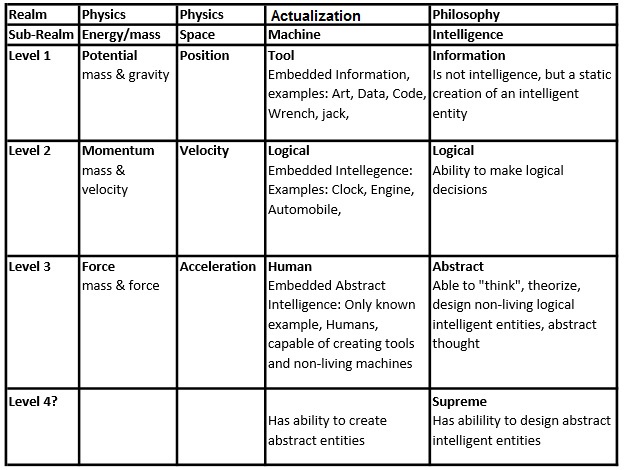
Table 1. Hierarchy of Realms
This engineer thinks of physics and philosophy as two different realms. And within these realms are different levels within the realm. As an example, in the realm of space (physics), there are the levels of position, velocity and acceleration. It seems to this engineer that there is a similar hierarchy of intelligence (philosophy) that would be information, logic and abstraction. The lowest level of each is similar insofar as a point really isn’t space and information really isn’t intelligence, but both are related to the realm they are in, and a product of their realm.
This engineer believes that it is proper to define another realm, actualization (process)25, as actualization is a combination of physics (matter, energy, space and time) and philosophy (intelligence). Similarly, tools, logically intelligent machines and abstract intelligent machines are levels of the actualization realm.
Intelligent Work Requires a Machine
This engineer’s definition of a machine is: an assembly of parts and energy that performs intelligent work. It takes the ingenuity of an Abstract Intelligent entity to design a specific assemblage of material that, with the appropriate energy source, perform the logic functions (hold matter in the machine in a defined, off equilibrium internal potential energy point) to perform intelligent work.
We engineers design and build entities that are, or include processes. The designing and building of any entity, static or dynamic, is a process in itself. But any dynamic device such as a vehicles, computer, manufacturing or processing plant, motor, engine, has process(es) running in it. They all have embedded intelligence and do intelligent work using machines.
Such entities may also include tools. Tools are static entities designed and built by an logically intelligent entity, or an abstract intelligent entity, that have embedded information, but no intelligence. Again, tools, by this definition include things we would not associate as being a tool, such as art, jewelry, sensors, glass, lubricants, passive electrical components that are in addition to hammers, screw drivers, saws, etc. that we normally think of as tools.
All Living Things are Machines – And More
According to these definitions life is a machine on the basis that logic must be embedded in the cell to make it work, distinguishing it from anything that natural causes can accomplish. And life, as far as we can tell, follows the laws of physics, has embedded intelligence and it (life) performs intelligent work. So, from a definition point of view, life is a machine. However, it is much more. It can reproduce. It can evolve. In the case of humans, it has abstract intelligence – a mind. Even the Supreme Actuatizer is a machine – one that actualizes at all size scales.26
We humans can and do design incredible machines – but we cannot design life. For one thing, we cannot “hand-build” a folded, functional protein molecule27This is possibility a false statement, but I don’t think so. It is based on what I’ve read and a discussion with Steve Meyer. It is my understanding that protein molecules can be produced by careful laboratory controlled processes. By controlling the reactants, temperatures profiles, protein molecules will be produced. However the specificity of the chain and it’s fold cannot be controlled and so ending up with a functional protein is problematic.[/Note] [Note]Reference Doug Axe work[/Note]
Our fingers are too big. We can “tweak” life’s molecules only by using the machinery that living matter supplies. We can create logical intelligent devices – robots that can do incredible things. But robots can only do what we can logically program them to do. And yes, we can and do create algorithms that can allow robots to learn. Eventually, we could probably develop robotic capability such that they could build their own parts and build and repair themselves. But this engineer doubts that humans will ever be able to build robots that can reproduce like living organisms, or to have abstract intelligence.
The Hierarchy of Intelligence
Humans have the ability to design and build (create) machines in the macro world that do incredible things. But humans cannot create life as we know it – our fingers are too big and we do not have the intelligence to design something that is as “smart” as we are. Obviously this is an opinion of this engineer and is not shared by everyone. But if this limitation is true, then the hierarchy shown in Table 1, but more clearly in Figure 3, exists.

Figure 3. Hierarchy of Intelligence
This Figure 3 can be opened up in a separate window by clicking on it. Each box represents an entity. Each column represents different forms of entities. The left column lists the actualizations that occur in our universe – the physical reality that we experience. The Universe entity box surrounds the header title to indicate that the actualizations are in the realm of the Universe and follow the laws of physics of the Universe. It wraps around the human actualization processes because those actualizations occur in our universe.
We do not know where or how the “supreme actuator” actuated, so it is not shown as being “in our universe” which may or may not represent reality.
Figure 3 also assumes the “supreme creator” created the universe and solar system. If one does not have that point of view, that the universe and solar system exist from natural causes, then remove the Universe and Earth creation boxes. They have no bearing on the discussion herein and are not mentioned elsewhere on this site. However, since we know from the proof above that life cannot be accounted for by natural causes, the create life and human boxes must remain unless some other explanation can be made for our existence other than a superior intelligent entity.
The three realms listed are Science (physics), Actualization (Actualization Processes) and Philosophy (intelligence/logic). We already know about Science and Philosophy, Actualization is new. It perhaps should not be considered a separate realm, rather a combination of Science and Philosophy, hence the arrows illustrating this connection. It exists as an artifact because of the fact that intelligent manipulation of matter and energy makes it possible to create a whole new class of creations – all the kinds of entities that life, especially man, creates, but most important, life itself.
The realm of philosophy, in the form of information, logical intelligence, abstract intelligence and supreme intelligence are inherent by the presence of these properties in the creators and the creations. For this reason, color codes are used to signify levels of intelligence. This shows that it took a supreme intelligence to create life and life with abstract intelligence, and it takes at least abstract intelligence to create entities with logical intelligence or with embedded information.
Another central theme is that all actualizations are actualized by an entity that uses machines doing intelligent work to execute a process designed by the actualizer. The term actualizer is used instead of designer because to an engineer, the design process is just one task of many to create a product.
It is the view of this engineer that the term “design” by those in the field of biology covers all aspects of actualization (the process of bringing something into existence). The design portion of creation is a mental process, which is not in the realm of physics, rather the realm of philosophy. The actual building of the “something” is physical, is in the realm of physics. Actualization is a process that merges the realms of philosophy and physics. This is a fundamental understanding that is missing from the arguments put forward by both the Materialists and the Intelligent Design community.
From Intelligence to Actualized Entities
Philosophers have forever recognized the difference between living and nonliving things. Living things contain much more detail and do many more things than natural causes are able to do. However, today we are being taught that science can explain everything, there is no need to invoke a creator to explain the existence of life. This prospect can be disproved if one can show scientifically that natural causes cannot produce (as opposed to design) the molecules we find in our life.28 This is the approach taken here – an engineer’s way of thinking about the problem. An engineer finds out if his mental design, and the science behind it, are valid by the success or failure of converting a mental design to a physical reality.
The Thermodynamic Impact of Intelligence
From a thermodynamic point of view, the addition of intelligence with physics has an additional energy cost, above all other thermodynamic considerations, just to be able to do intelligent work. This expenditure exists as long an the machines that are doing the intelligent work are “running”. The amount of energy actually consumed is a function of the design of the machine, how long it it running and how hard it is working. There is no way to be able to relate entropy change due to intelligent work or to the amount of energy consumed.
There is an energy cost related to the realm of Actualization, and it should be somehow stated as a law that relates the realms of physics and philosophy. And perhaps there should be a term designated for the ongoing energy required to supply intelligence for an intelligent machine.
It Starts With Intelligence
The term intelligence is used differently by different people and professions. Most people use the term as associated with humans – the ability to think, comprehend, analyze. Engineers also use the term to indicate ability to process information, like a computer program. The military uses the term for information that has military value. It is important to understand that intelligence in all forms is not a physical entity, it is an ability to process information. For purposes of this discussion, we need to consider different levels of intelligence and propose the terminology described below.
Information
Information is not really a level of intelligence, rather it is a product of intelligence. It is static, non-material/energy/space/time abstraction that is the product of an intelligent entity, not science/physics. However, information can be embedded into matter based on designed languages and/or protocols and/or codes and/or standards. Examples include the information carried by books, tapes, CD’s, computer memory, hand writing, and DNA. These are examples where information is embedded in matter for the purpose of storing the information for some later use by an intelligent device, such as a computer, a TV set, an audio player and in the case of DNA, the information needed to run the cell’s life process. Information of this sort can only be created by an abstract or supreme intelligent entity.
But information can also be embedded in matter to provide function other than to store the information. It can be manipulated to form art or to be tools. Examples are paintings, sculptures, jewelry, hammer, nails, pliers, windows, passive electronics parts, birds nest, and bee hive. Items that fall into this category of actualizations can be actualized by entities that have abstract or logical level of intelligence as illustrated in Figure 1.
Logical Intelligence
Logical intelligence is the ability to make decisions based on conditions or circumstances. The simplest form is a binary switch. An example would be a switch that is off when there is sufficient light, and turns on when there is insufficient light. A logical device must have means to receive an informational input signal, in this case a light sensor, and an output, in this case a light bulb and power source. A characteristic of any logical device is that it requires energy to perform the logical function – it takes energy to operate the light sensor and to flip the light switch in this example.
All machines have some sort of embedded logic. Think of an engine. The logical functionality is the result of the shape of the crankshaft and camshaft and valves, the timing of the ignition spark all coordinate the component parts to be in the proper position to make the engine work. But it requires an Abstract intelligence to design the engine as shown in Figure 3.
Abstract Intelligence
Abstraction is the ability to think, invent, to deal with ideas. This capability goes beyond logical processing of information. It is a capability that is unique to humans among life on earth. Even though humans have this capability, it is the opinion of this engineer that we will not be able to duplicate this capability in machines of our design unless we can “reverse engineer” this capability in ourselves.
Engineering – Actualization Using Science & Intelligence
Philosophers have forever recognized the difference between living and nonliving things. Living things contain much more detail and do many more things than natural causes are able to do. However, today we are being taught that science can explain everything, there is no need to invoke a creator to explain the existence of life. This prospect can be disproved if one can show scientifically that natural causes cannot produce (as opposed to design) the molecules we find in our life.29 This is the approach taken here – an engineer’s way of thinking about the problem. An engineer finds out if his mental design, and the science behind it, are valid by the success or failure of converting a mental design to a physical reality.
The Thermodynamic Impact of Intelligence
From a thermodynamic point of view, the addition of intelligence with physics has an additional energy cost, above all other thermodynamic considerations, just to be able to do intelligent work. This expenditure exists as long an the machines that are doing the intelligent work are “running”. The amount of energy actually consumed is a function of the design of the machine, how long it it running and how hard it is working. There is no way to be able to relate entropy change due to intelligent work or to the amount of energy consumed.
There is an energy cost related to the realm of Actualization, and it should be somehow stated as a law that relates the realms of physics and philosophy. And perhaps there should be a term designated for the ongoing energy required to supply intelligence for an intelligent machine.
It Starts With Intelligence
The term intelligence is used differently by different people and professions. Most people use the term as associated with humans – the ability to think, comprehend, analyze. Engineers also use the term to indicate ability to process information, like a computer program. The military uses the term for information that has military value. It is important to understand that intelligence in all forms is not a physical entity, it is an ability to process information. For purposes of this discussion, we need to consider different levels of intelligence and propose the terminology described below.
Information
Information is not really a level of intelligence, rather it is a product of intelligence. It is static, non-material/energy/space/time abstraction that is the product of an intelligent entity, not science/physics. However, information can be embedded into matter based on designed languages and/or protocols and/or codes and/or standards. Examples include the information carried by books, tapes, CD’s, computer memory, hand writing, and DNA. These are examples where information is embedded in matter for the purpose of storing the information for some later use by an intelligent device, such as a computer, a TV set, an audio player and in the case of DNA, the information needed to run the cell’s life process. Information of this sort can only be created by an abstract or supreme intelligent entity.
But information can also be embedded in matter to provide function other than to store the information. It can be manipulated to form art or to be tools. Examples are paintings, sculptures, jewelry, hammer, nails, pliers, windows, passive electronics parts, birds nest, and bee hive. Items that fall into this category of actualizations can be actualized by entities that have abstract or logical level of intelligence as illustrated in Figure 1.
Logical Intelligence
Logical intelligence is the ability to make decisions based on conditions or circumstances. The simplest form is a binary switch. An example would be a switch that is off when there is sufficient light, and turns on when there is insufficient light. A logical device must have means to receive an informational input signal, in this case a light sensor, and an output, in this case a light bulb and power source. A characteristic of any logical device is that it requires energy to perform the logical function – it takes energy to operate the light sensor and to flip the light switch in this example.
All machines have some sort of embedded logic. Think of an engine. The logical functionality is the result of the shape of the crankshaft and camshaft and valves, the timing of the ignition spark all coordinate the component parts to be in the proper position to make the engine work. But it requires an Abstract intelligence to design the engine as shown in Figure 3.
Abstract Intelligence
Abstraction is the ability to think, invent, to deal with ideas. This capability goes beyond logical processing of information. It is a capability that is unique to humans among life on earth. Even though humans have this capability, it is the opinion of this engineer that we will not be able to duplicate this capability in machines of our design unless we can “reverse engineer” this capability in ourselves.
Our Hands Are Too Large
From this engineer’s perspective, the fact that life is an intelligently controlled process is the easiest way to appreciate and understand the difference between living and non-living matter; that life is matter with embedded intelligence.
The field of electronics deals with devices in the nm range, which is the same size range of proteins. But there are several differences between ultra-small electronic entities compared to life molecules. Electronic chips are layered two dimensional static devices, compared to life molecules that, in the living condition, moving in all three dimensions. The other big difference is that even though the electronic structures at these dimensions are hard to see, the designs normally supply larger test points that allow the engineer to discern what is happening even at these small dimensions by electrical measurements. The point is that we do not have the means to track exactly what is happening inside the cell because “our fingers are too large” and we cannot see or probe inside the cell walls to “reverse engineer” the life process that is in motion. It is of great interest to this engineer to learn how the knowledge of the cell’s inter-workings has been obtained, and to what degree we understand it.
Past, Present, Future
However, the bio-medical field is doing amazing things involving manipulating of the genome. This engineer is clueless how these feats are accomplished. The assumption is that researchers are learning how to use the cellular machinery to determine functionality indirectly. This is a scary because it is obvious that the overall understanding of the process control system in the cell is very limited. In addition, the lack of knowledge of process control in general leads to the prospect of not appreciating the probable interrelationships between the numerous control loops that must exist in the cell. This could lead to unintended consequences, some which could be very subtle and/or dangerous.
It has been intuitively obvious to man since the earliest recorded history that life was something much different from inanimate nature. Darwinism has given those who do not want to believe that an intelligent entity was responsible for our existence a way, as Dawkins put it “to be intellectually fulfilled.” To others, life itself, is proof that there must have been some intelligent intervention with nature in order to create life.
The reality is that we do not understand the totality of physics; like dark matter and energy, gravity, entanglement and the photon wave/particle/detection conundrum. Perhaps if we did, we would know which side of this chasm is correct. The science we do (or think we do) understand leaves Darwinism in a black hole.
Purpose of This (ID) Site
This site meant to be a forum to discuss the validity of this line of reasoning. It is the hope that there are others, particularly thoughtful engineers who share some of these ideas and would like to help improve our understanding of life.
It seems obvious that the fields of biology and engineering are merging, and it is exciting to be able to participate in this merger. If this engineer was a young man, he would become a bio-engineer.
This engineer, being very interested in understanding what is known about life; what it is and how it works, has spent countless hours reading and thinking about the topic. The engineer’s perspective is quite different from the Darwinist point of view and the differences have many implications: thermodynamic, theoretical, philosophic, political, and theological.
The key to understand life, it seems to this engineer, is to understand the details of how the life process works. As mentioned, this is hard because our fingers and eyes are too big. Engineers like myself have ideas about what to be looking for. But we (speaking for myself) have only a little knowledge of what currently is known, and almost zero knowledge about the tools available to gain additional knowledge.
So the purpose of this site is to serve as a forum for this engineer and others to share ideas, learning resources and, in general, be a place to kindle thinking on the topic.
To submit a post, please use the Contact form in the footer.
Contact
© 2016, 2017
- This video can be seen at this site at the 15-minute point. He narrated the video, explaining what the video was depicting.
- See “Molecular Machines in the Cell“, Post by Casey Luskin, 2010, Discovery Institute
- ibid
- Expand on this – use a factory as an example – find pictures of robotic machine assembly line and discuss various levels, support, etc. Then discuss the “biology” life process, food chain, changing the atmosphere, ocean water, etc., etc.
- (NTS) Write about any action to achieve an end is a process. So there is a hierarchy of process, they are embedded with others, they are layered, etc.. Give examples.
- (NTS) Have a chapter on trade-offs. Tthere is no such thing as a perfect design. Materialists that claim there can be no God because if God was real, things would be perfect – no God would allow suffering. Not true. Even God had to deal with trade-offs when it comes to the engineering of life. Not only that, the more complex a design is, the more trade-offs that come into play due to all of the interactions of “features”. Tracking the development of software, say Windows, or of a product, like iPhone should convince anyone of that fact!
- Another (NTS). Desire book I’m reading talks about “First/Second Laws of Life” (or biology) as if figuring out what these “laws” are, you’ve solved the puzzle. Well each law must have a causation, a mechanism that makes it so – or a process that occurs that make it true. A discussion of this could be a chapter in the book.
- “Imaging Live-Cell Dynamics and Structure at the Single-Molecule Level”, Molecular Cell,Volume 58, Issue 4, 21 May 2015, Pages 644-659 .
- See post “Our Fingers Are Too Big“
- McIntosh, Andrew, “Top Down or Bottom Up Development in Living Systems?”, International Journal of Design & Nature and Ecodynamics, Vol. 4 No. 4 (2009) 351-385, Paragraph 5.2.2.
- Van Schoiack, Mike, M. “Fake Physics”, https://cs21c.com/fake-physics/.
- ibid
- Lattimer, “Chemical Evolution Theory of Life’s Origins”, AST w48, Lecture 13, p1-2., available at this website.
- (NTS) Finish this section. The most direct and profound reason that Natural Causes cannot account for beginning life, or from any machine that man creates, is the fact that Natural Causes can cause only a subset of all possible configurations of matter/energy. The laws of physics is the reason.
- That I can think of…
- This is the definition one gets by doing a Google search.
- Again, the Google search definition
- This link is to a post that explains how my college physics textbook, shown here, explains how it is theoretically possible for a lake to suddenly freeze over on a warm day, and I explain why (I think) it is wrong
- Even though it has been shown that the statistical probability of a single functional protein forming by natural causes is inconceivably high, the perception is that it is possible. The argument presented here reduces the probability to zero.
- The term “Creation” is a more accurate descriptor for conceiving, designing, and building something. But doing so invokes the young earth belief which is not held by the majority of theists, and this debate is not something this engineer wants to get in the middle of. However, there must be a better term than “Actualization”, and this engineer is open to suggestions. [update – In addition, the idea of “creating a new realm”, on second thought, is probably not a good idea. The notion of doing so is the result of creating Table 1 and Figure 3. More thinking about this is needed.
- This is based on the premise that the proof given above is true, something that needs to be validated
- McIntosh, Andrew, Information and Entropy – Top Down or Bottom Up Development in Living Systems?, Int. J. of Design & Nature and Ecodynamics, Vol. 4 No. 4 (2009) 351-385, Paragraph 5.2.2.[/Note]
Our Brain Shields Us From the Complexity of Processes
Think of the process of cooking a meal. Your first level of planning is to design a menu, and to determine means to get the food, prepare the food, cook, set the table and serve the meal. The second level is to write out the menu, listing each ingredient, the amount, the steps of preparation before cooking, the method, temperature and time and so on.
If you had to write a program for a robot to do this work, you would get to a level where you would have to provide instructions such as: position both arms, shoulder angle 180 degrees y-z plane, 5 degrees x-z plane, and elbow joint 90 degrees, palm up. Move from coordinates: x1, y1, facing θ1 to coordinates: x2, y2, facing θ2 , etc.
And it gets worse. At an even higher level, there would have to be instructions, for each of the instructions above, that commanded each actuator, e.g.: relax interior shoulder actuator, extend exterior shoulder actuator to position 22.2, relax exterior elbow actuator, retract interior elbow to position 13.4, with similar instructions for legs and all finger joints. And these have to be dynamic instructions – they change with time.
The reason for going through this exercise is to point out the fact that we become accustom to letting our brain take care of the details of our actions. We are a machine, and these levels of details instructions are being carried on, and our body is designing the steps and executing the instructions “on the fly” without our conscience mind being aware of them.
An engineer designing process control systems quickly becomes aware of this. Doing intelligent work is far more complex and involved than we realize. Think of all of the calculations that are required to figure out how hard to squeeze, which direction to turn, how big of a step to take, then convert this to actual commands to each muscle, etc., etc. One simply cannot appreciate the gap between perception and reality of complexity of doing intelligent work.
Every action going on within the cell must have equivalent detail plans and instructions to carry on the many tasks that must be occurring for the cell to live. This is incredible complexity. Imagine a building a city block square, with blackboards from floor to ceiling with logic block diagrams covering all the boards that detail the actions that are required in the cell. This is the kind of complexity that must exist. We fortunately know the “language” for building proteins, and some information about signaling. But for the most part, as far as this engineer can tell, we know very little else.
It is the belief of this engineer that the complexity of running a process as complex as life in the cell is still not comprehended by biologists. They do not recognize the degree of detail of action and decision making (control) that is required. If they did, they would expect that all of the DNA does have purpose – to execute the life process. There must be hundreds of individual process tasks with many steps being conducted that involve material, space and time in coordination with all the other process tasks that have to be going on at the same time. How is all of this accomplished? There is so much that is to be learned and discovered. It seems to his engineer that our profession could be of assistance to the field of biology as we have an idea of what to be looking for to make the life process work.
So far we’ve learned that DNA appears to be the database for the parts (proteins & RNA), and it must also be the “operating system” code. This functionality has to exist to run the life process. From it, RNA and proteins, are built, and apparently these parts end up being the control processor, sensors and actuators that do the physical work. The proteins/RNA involved with some functions have been identified, but beyond that very little, it seems to this engineer, is understood. Very likely the ratio of “learned” to “to be learned” is probably about equal to “protein expression DNA” to “non-protein expression DNA”. Upon learning the “what and how” of the rest of the DNA will most probably be surprises; technology we have not discovered analogous to the discovery of neural networks in the body. Until the detail functionality, both of the cell and organisms is reverse-engineered, for the most part, we will be in the dark.22Here is an article that supports the feeling that there is much to be learned. It also suggests that there are algorithms and design techniques involved that we probably do not understand.
- Even though there is only one output, the state of that output may, over time be in more than one state. For example, a system that exists in a mixture of reactants may have a probability of being more than a singular product, the result a result of a probability distribution.
- Or better yet, a more descriptive term – creation
- Here is a neat link to slider that shows the size of everything from a quarks and neutrinos (10-20M), to Nucleus (10-14M) to man (2M) to the sun (109M) to the Milky Way Galaxy (1021M) to the Universe (1027M)
- This means the actual functional molecules that exist in life, not molecules of the same form. Intelligence requires absolute precise specificity.
- This means the actual functional molecules that exist in life, not molecules of the same form. Intelligence requires absolute precise specificity.