
Paper: On The Limits Of Natural Causes

Paper: On The Limits Of Natural Causes

The concepts underlying the Intelligent Design section of this site are contained in this paper entitled “On the Limits of Natural Causes” in a published paper format.

Here is the abstract:

Abstract

 The debate surrounding the origins of first life focus on disproving the materialist doctrine that all that exists can be explained by matter, energy, space, time and the laws of physics and that there is a chemical pathway to first life. The Intelligent Design (ID) argument is that life is very complex, requiring high degrees of specified information, design, with vast coherence, making the probability of natural causes finding a viable life solution orders of magnitude longer than the age of the universe.

This paper posits another, more powerful ID argument based on three premises: 1) that outcomes of natural processes, defined as processes that follow the laws of physics with no intelligence involved, are limited due to logical constraints, 2) life is an intelligent process which requires machinery to function , and 3) machines require embedded intelligent functionality which is beyond the reach of natural causes.

The rationale behind these premises is explained in this paper, and a simple means of falsifying them posited. The necessity to consider not only the design of life but the actual building, starting and operation of life is invoked by the arguments presented here. The research for this paper lead to findings that have significance:

  1. They show that there is intelligence embedded in life meaning that life itself is not just science, it is science plus logic (intelligence) which is in the realm of philosophy,
  2. They move the ID argument natural causes created life from being insanely improbable to impossible,
  3. They provide the basis for definitive, coherent definitions of life, science, engineering and philosophy,
  4. They provide methods to falsify the idea that there is a chemical pathway to first life, and that natural causes can create machines.


Link to this paper.

© 2018 Mike Van Schoiack


© 2016 Mike Van Schoiack

Designed by Mike Van Schoiack, Powered by WordPress/Divi
A Macro World Emzyne Analogy

A Macro World Emzyne Analogy

It was pointed out in the “Fake Biology” post that the world of biology defines an enzyme to be a protein catalyst, and a catalyst to be a molecule that “speeds up a chemical reaction.

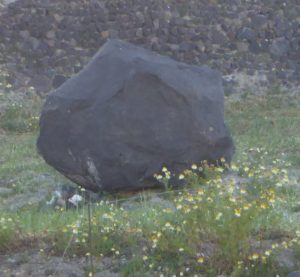
This post is being written while spending time with family and friends at a celebration in Santorini, Greece.  Santorini is the remains of a volcano that exploded 3,700 years ago, destroying an advanced city thought by many to be the lost city of Atlantis.  Yesterday, we visited the archeological dig site of an ancient city on the volcano island and the tour guide pointed out what she called the rock “bombs” that flew out of the mouth of the exploding volcano and destroyed buildings.  There were a number of them on display there.

This picture, taken from the villa we are staying in, is one of these “bombs” on the hillside opposite the villa.  The  rock is precariously situated on the hillside, and will eventually roll down the hill due to erosion and/or an earthquake.

Someone in our group mentioned that a person with a shovel and a pry bar could do the same thing in 10 minutes.  Such an action by a human (intelligent machine) would speed up the natural process of erosion that reduces the activation energy required to dislodge the bomb. This is analogous to the intelligent work an enzyme does to “build” a molecule compared to the molecule being formed by a natural chemical reaction. This analogy works from a specificity point of view as well as a thermodynamics point of view because the human could control the timing of the event and the direction that the “bomb” would roll down the hill.

A close-up view shows that someone has stuffed stones to, in effect, increase the activation energy.  This is an example of intelligent work expended to offset the effects of natural causes.

© 2016 Mike Van Schoiack